AI’s growing appetite for electricity has sent tech companies searching for energy almost everywhere. Panthalassa thinks one answer is sitting in plain sight: the ocean.
The Portland, Oregon-based startup is reportedly raising about $225 million at a post-money valuation approaching $2 billion, according to The Information. The financing would roughly double Panthalassa’s valuation just three months after a $140 million round pushed the company close to the $1 billion mark.
The new round is reportedly being discussed with 8090 Industries and Hanwha Asset Management as co-leads, with other investors expected to participate. Hanwha backed Panthalassa’s previous financing.
“A startup that aims to run data centers with energy from ocean waves is in talks to double its valuation to $2 billion,” The Information reported.
The fundraising would put a striking price tag on one of the more unusual attempts to solve AI’s infrastructure problem. Instead of building another giant data center and then finding enough electricity and cooling to keep it running, Panthalassa wants to move the computers to where both are abundant.
That means putting AI servers at sea.
Fundpluse reported on Panthalassa in May after the Peter Thiel-backed startup raised $140 million in fresh funding at a valuation close to $1 billion. That round included investors such as John Doerr, Marc Benioff’s TIME Ventures, Max Levchin’s SciFi Ventures, Susquehanna Sustainable Investments, Hanwha Asset Management, Super Micro Computer, Gigascale Capital, and Lowercarbon Capital.
Panthalassa wants to put AI compute where the waves are
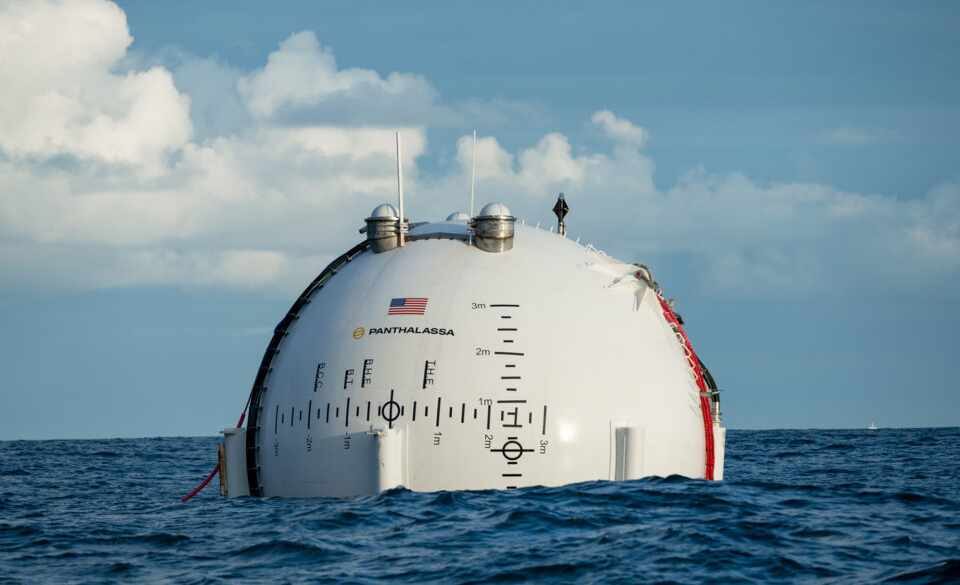
Founded in 2016 by CEO Garth Sheldon-Coulson, Panthalassa has spent a decade developing large autonomous floating structures it calls nodes. Each is intended to convert wave movement into electricity and consume that electricity on-site to run GPUs.
The concept turns the traditional data center model around. Rather than generating electricity offshore and sending it back to land through expensive subsea cables, Panthalassa plans to process AI workloads aboard its ocean nodes and transmit the resulting data through low-Earth-orbit satellite connections.
A full-size node is expected to measure roughly 85 meters, or about 280 feet, with most of the steel structure submerged. Wave motion forces seawater through an internal system that drives a turbine. The company has said a node could generate roughly 1 megawatt continuously under suitable conditions.
Credit: Panthalassa
The ocean provides another benefit: cooling. Servers would sit inside sealed containers surrounded by cold seawater, reducing the need for the air-conditioning equipment and freshwater cooling systems common in large terrestrial data centers.
Panthalassa says its system could eventually produce electricity for roughly 2 cents per kilowatt-hour and achieve capacity factors above 90%. Those figures remain company projections and will need to be demonstrated at commercial scale.
“We’ve built a technology platform that operates in the planet’s most energy-dense wave regions, far from shore, and turns that resource into reliable, clean power,” Sheldon-Coulson said in May.
The company has already built and tested smaller prototypes. Ocean-1 arrived in 2021, followed by sea trials of Ocean-2 off Washington state in 2024. Panthalassa has targeted its Ocean-3 generation for pilot deployment in the northern Pacific in 2026, followed by commercial operations in 2027.
The timing helps explain investor interest.
AI infrastructure spending has exploded as companies race to secure GPUs, electricity, land, cooling capacity, and grid connections. Some proposed data centers face years-long waits for grid access. Others have run into opposition over electricity consumption, water use, and their impact on local communities.
Panthalassa proposes a very different tradeoff. Move compute offshore, generate electricity where it is consumed, use seawater for cooling, and transmit information instead of electricity.
That sounds elegant on paper. The ocean gets the final vote.
Saltwater corrosion, storms, marine growth, satellite connectivity, maintenance logistics, manufacturing costs, and environmental regulation could all complicate the economics. Wave energy has attracted ambitious projects for decades without reaching the scale achieved by solar and wind. Running fleets of autonomous data centers far offshore adds another layer of technical risk.
Panthalassa is betting that mass production can change that equation. Its nodes are intended to be built largely from plate steel and self-propel to regions with favorable wave conditions, away from busy shipping routes.
The company is structured as a public-benefit corporation and has recruited people with experience at SpaceX, Tesla, NASA, Google, Apple, Blue Origin, Boeing, and other engineering-heavy organizations.
Peter Thiel framed the opportunity in characteristically large terms after the May financing.
“The future demands more compute than we can imagine. Extraterrestrial solutions are no longer science fiction. Panthalassa has opened the ocean frontier.”
Investors now appear prepared to place an even larger bet on that frontier. If Panthalassa completes the reported $225 million raise near a $2 billion valuation, its worth will have roughly doubled in a matter of months, before its floating data centers have reached commercial deployment.
That makes the next year far more consequential than the valuation itself. Panthalassa has spent a decade proving that its idea can work. Now it has to prove that AI data centers really belong at sea.