Hadrian has raised $1.37 billion in fresh funding at a $7.87 billion valuation, more than quadrupling its valuation since January as investors pour record sums into startups rebuilding America’s defense manufacturing base.
The Series D was co-led by WCM Investment Management, Washington Harbour Partners, Valor Equity Partners, 137 Ventures, and Baillie Gifford, with JPMorgan Chase’s Strategic Investment Group serving as anchor co-lead. Andreessen Horowitz, Founders Fund, Lux Capital, and other investors joined the round.
The size of the deal puts Hadrian among the most heavily funded defense-tech and advanced manufacturing startups in the U.S. It comes amid a surge in Pentagon spending and growing concern that American factories cannot produce submarines, munitions, drones, and other military equipment quickly enough to meet rising demand.
Hadrian wants to attack that problem by changing how those factories operate.
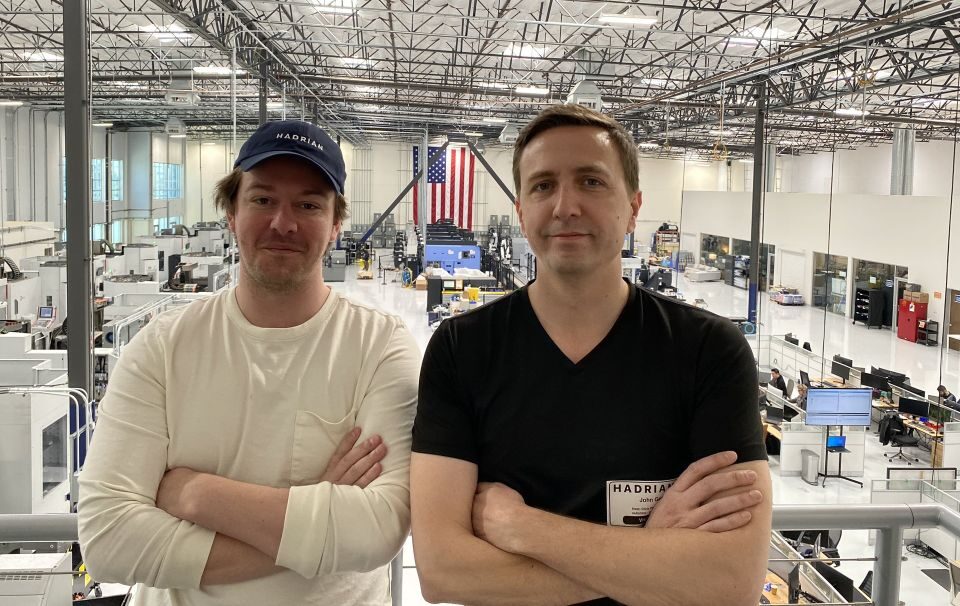
Founded by CEO Chris Power, the company builds highly automated factories for aerospace, defense, and industrial customers. Its manufacturing facilities pair automation with a software platform called Opus, which manages factory operations and production.
“It enables us to make massive investments to scale our workforce, our software platform Opus that powers our factories, and frankly, get ahead of the massive amounts of production challenges the country has in areas like submarines, munitions, the drone industrial base,” Power told CNBC’s Morgan Brennan on Thursday.
Power said Opus is already being used by the U.S. Army and Navy, with more defense prime contractors expected to be announced.
“With physical AI sweeping the physical economy, which is 100 times larger than the digital economy, everyone’s going to need to rebase their software to adapt and compete in this new world,” Power told CNBC.
Defense-tech investors are writing much bigger checks
Hadrian’s huge round is part of a broader shift in Silicon Valley, where defense startups have gone from a relatively niche venture category to some of the industry’s largest private companies.
Fundpluse first covered Hadrian last year after the company raised $260 million in Series C funding led by Peter Thiel’s Founders Fund and Lux Capital, with participation from Andreessen Horowitz and Altimeter Capital. That financing was aimed at building another factory and increasing production capacity for naval defense programs.
Hadrian now finds itself in increasingly expensive company.
Palmer Luckey’s Anduril Industries has become one of the clearest examples of investor appetite for defense tech. The autonomous weapons and defense systems company raised $2.5 billion in a funding round that valued it at $30.5 billion, then saw its valuation climb above $60 billion two months later.
Shield AI, which develops autonomous aircraft and AI systems for military operations, raised funding in March at a $12.7 billion valuation. Autonomous shipbuilder Saronic reached a $9.25 billion valuation in another financing round.
The common thread is a push to rethink how military hardware gets built.
For decades, U.S. defense manufacturing has depended heavily on large contractors, sprawling supply chains, specialized suppliers, and factories that can take years to increase output. The wars in Ukraine and the Middle East, growing tensions in the Indo-Pacific, and depleted weapons inventories have exposed limits in that model.
The Trump administration is seeking defense spending of $1.5 trillion, putting further pressure on the industrial base to produce more equipment at lower cost and shorter timelines.
Hadrian is betting that software-controlled factories can help close that gap. Rather than competing primarily by designing another missile, drone, or aircraft, the company is working on the manufacturing infrastructure needed to produce the components behind those systems.
That distinction makes Hadrian an interesting bet in the defense-tech boom. Every new autonomous aircraft, submarine, drone, and weapons platform still has to be manufactured somewhere.
Investors are now valuing the factories behind those systems almost as aggressively as the companies designing them.
Hadrian’s jump from roughly $1.8 billion in January to $7.87 billion today suggests Wall Street and Silicon Valley increasingly see defense manufacturing capacity itself as strategic technology.
Why It Matters
The defense-tech boom is moving deeper into the industrial base. Billions of dollars have already flowed into autonomous weapons, drones, ships, and military AI. Hadrian’s $1.37 billion round shows investors are making another bet: the next bottleneck may not be inventing new defense technology, but building enough of it.