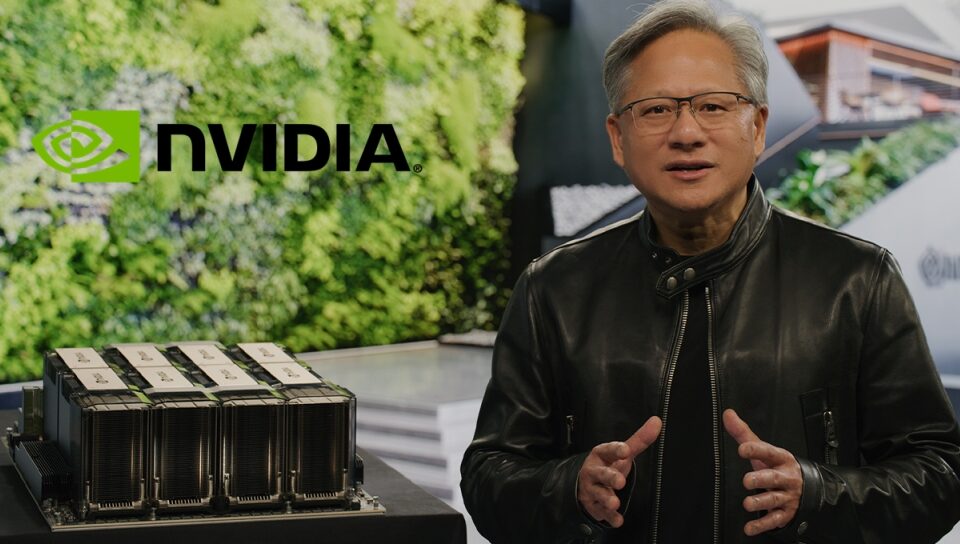
Nvidia just rewrote history. The chipmaker became the first company on the planet to hit a $5 trillion market valuation, fueled by an AI-driven rally that’s reshaping both Wall Street and Silicon Valley.
The milestone cements Nvidia’s rise from a niche graphics-chip designer to the backbone of the artificial intelligence economy — and turns CEO Jensen Huang into a defining figure of this era. The company’s chips have become the gold standard for training and running large language models, making Nvidia the center of a global race that now spans boardrooms, data centers, and geopolitics.
Shares surged more than 4% on Wednesday, pushing Nvidia beyond the $5 trillion mark and widening its lead over Big Tech peers, CNBC reported. The news comes just a day after Apple and Microsoft each hit the $4 trillion market cap milestone, underscoring how AI continues to reorder global market leadership. Nvidia’s stock is up more than 50% this year, extending a rally that began when ChatGPT ignited the AI boom in late 2022. Since then, Nvidia’s valuation has jumped twelvefold, propelling the S&P 500 to record highs and stirring debate about whether the AI trade is becoming the next big bubble.
The latest surge came after Huang revealed $500 billion in AI chip orders and plans to build seven new supercomputers for the U.S. government. The announcement reinforced Nvidia’s dominance in high-performance computing and its growing influence in U.S. industrial and defense strategy. The company also disclosed a $1 billion stake in Nokia as part of a strategic partnership to develop next-generation 6G cellular technology — a move that further signals Nvidia’s ambitions beyond chips.
“Nvidia hitting a $5 trillion market cap is more than a milestone; it’s a statement,” Matt Britzman, senior equity analyst at Hargreaves Lansdown, told Reuters. “Nvidia has gone from chip maker to industry creator. The market continues to underestimate the scale of the opportunity, and Nvidia remains one of the best ways to play the AI theme.”
Nvidia’s $5 trillion milestone makes history — and puts pressure on rivals Apple and Microsoft
The rally has also boosted Huang’s personal wealth, now estimated at around $179 billion based on his stake in the company, making him one of the richest people in the world. Born in Taiwan and raised in the U.S. from age nine, Huang founded Nvidia in 1993 and spent decades building the company through gaming, data centers, and now AI dominance. Its H100 and Blackwell processors are the engines behind ChatGPT, xAI, and most large-scale AI systems in production today.
The company’s rise has made it a key player in U.S.-China relations. President Donald Trump is expected to discuss Nvidia’s Blackwell chip with Chinese President Xi Jinping this week, as Washington continues to enforce export controls on advanced chips. Nvidia now finds itself both a national asset and a geopolitical bargaining chip in the race for AI supremacy.
Even with rivals like AMD and a wave of AI startups chasing its lead, Nvidia remains the industry’s benchmark. Analysts say the rally reflects investors’ belief that AI spending has no signs of slowing — though some warn that valuations could be running ahead of reality. “AI’s current expansion relies on a few dominant players financing each other’s capacity,” said Matthew Tuttle, CEO of Tuttle Capital Management. “The moment investors start demanding cash-flow returns instead of capacity announcements, some of these flywheels could seize.”
Nvidia’s influence now stretches across global markets. Its weight in the S&P 500 and Nasdaq 100 means every movement in its stock reverberates across the financial system. The company is set to report quarterly earnings on November 19, a date investors are already watching closely.
At $5 trillion, Nvidia’s valuation now surpasses the combined market cap of the entire cryptocurrency sector and equals roughly half the size of Europe’s Stoxx 600 index. For a company that started by building gaming chips three decades ago, the climb has been nothing short of extraordinary — and its dominance in the AI race shows no sign of slowing.